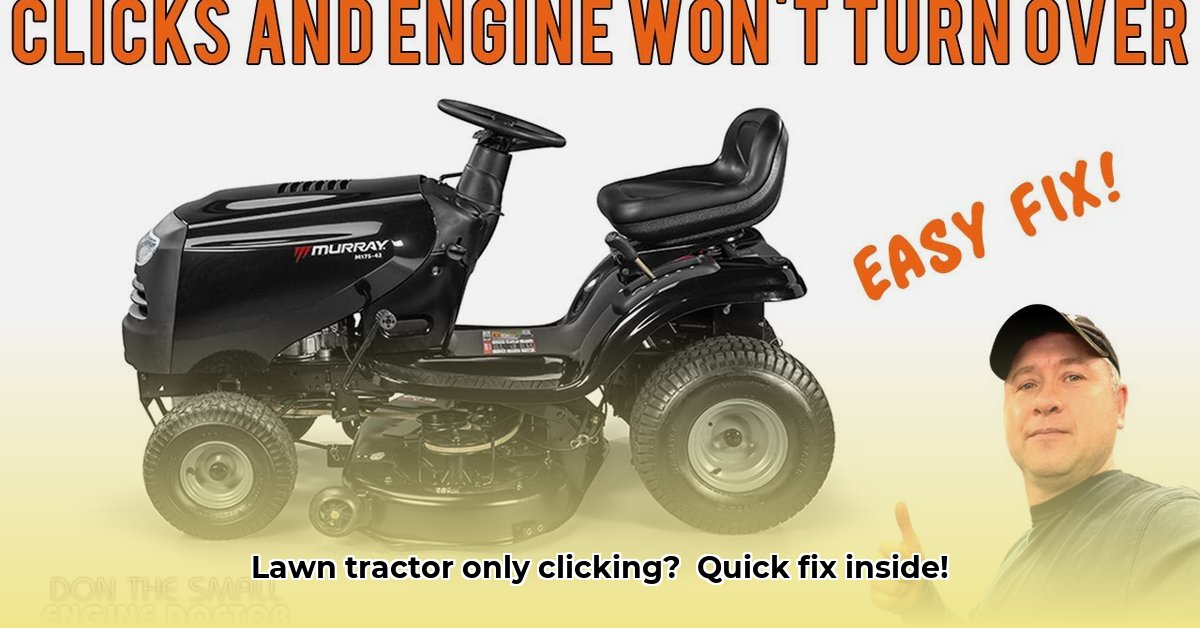
That annoying clicking sound from your lawn tractor, but no start? This common problem often has a simple fix. This step-by-step guide will help you diagnose and resolve the issue, saving you time and money. We'll cover everything from basic checks to more advanced troubleshooting, and when to call a professional. For more in-depth troubleshooting, check out this helpful resource: Bolens troubleshooting.
1. Battery: The Power Source
A dead or weak battery is the most frequent cause of a clicking sound without starting. It's the heart of your tractor's electrical system.
Step 1: Visual Inspection. Examine the battery terminals. Corrosion (a greenish-white buildup) hinders electrical flow. Clean terminals with a wire brush and a baking soda paste, then rinse with water.
Step 2: Voltage Check (Tools Needed: Multimeter). With the key off, use a multimeter to measure voltage across the battery terminals (positive to positive, negative to negative). A fully charged battery should read around 12.6 volts. Lower voltage indicates needing a charge or replacement.
Step 3: Secure Connections. Tighten all battery cables. Loose connections can disrupt the electrical current as much as a dead battery.
2. Safety Switches: Essential Safety Measures
Several safety switches prevent accidental starting. A tripped switch can easily be the cause of the clicking sound.
Step 1: Seat Switch. Ensure you are firmly seated. Many tractors won't start unless the seat switch senses weight.
Step 2: PTO (Power Take-Off) Switch. If your tractor has a PTO (for attachments like a mower deck), make sure it's fully disengaged. An engaged PTO often prevents engine cranking.
Step 3: Brake Pedal Switch. Check your owner’s manual, but on many models, depressing the brake pedal is required to start the engine.
Step 4: Other Switches. Consult your owner's manual for additional safety switches.
3. The Solenoid: The Electrical Relay
The solenoid is an electromagnetic switch that connects the battery to the starter motor. A faulty solenoid is a common reason for clicking.
Step 1: Locate the Solenoid. Usually near the battery and starter motor. Consult your owner's manual for the exact location.
Step 2: Solenoid Testing (Advanced, Tools Needed: Multimeter). This requires checking continuity (electrical connection) between solenoid terminals. If there's no continuity, the solenoid needs replacement. Important: Disconnect the negative battery terminal before any electrical testing. This is best left for experienced individuals.
4. Starter Motor: Cranking the Engine
If the battery, connections, safety switches, and solenoid are fine, the starter motor might be the problem. This motor cranks the engine. A faulty starter motor is a more serious issue.
Step 1: Assessment. This is highly involved and may require removal of the starter motor for inspection. It is usually best left to a professional mechanic.
5. Wiring: Connections and Current Flow
Worn, damaged, or corroded wiring can disrupt the flow of electricity.
Step 1: Visual Inspection. Carefully inspect all wires connected to the battery, solenoid, and starter motor. Look for fraying, corrosion, or loose connections. Repair or replace as needed.
Step 2: Check for Broken Wires. Look for broken or disconnected wires. This is often easily solved with a simple visual inspection.
When to Call a Professional
If, after these steps, your tractor still only clicks, it’s time to call a qualified mechanic. Complex electrical or internal engine problems require specialized knowledge and tools.
Preventative Maintenance: Avoiding Future Issues
Regular maintenance prevents problems and improves the lifespan of your tractor.
| Maintenance Task | Frequency | Description |
|---|---|---|
| Battery Terminal Cleaning | Monthly (or as needed) | Clean terminals with a wire brush and baking soda solution to remove corrosion. |
| Cable Inspection | Annually | Check for fraying, damage, or loose connections. Replace as needed. |
| Safety Switch Inspection | Before each use | Ensure all safety switches are functioning correctly. |
| Seasonal Maintenance | Before storage | Clean the tractor, change the oil, and fully charge the battery. |
Always disconnect the negative battery terminal before electrical work. Safety is paramount.
Key Takeaways: A clicking lawn tractor often points to electrical issues. Systematic troubleshooting, starting with simple checks and progressing to more complex ones is crucial. Preventative maintenance is key to avoiding costly repairs and downtime. Regular inspections and knowing when to call a professional will keep your lawn tractor running smoothly.